
What the Grand County Owner-of-Record Result Shows
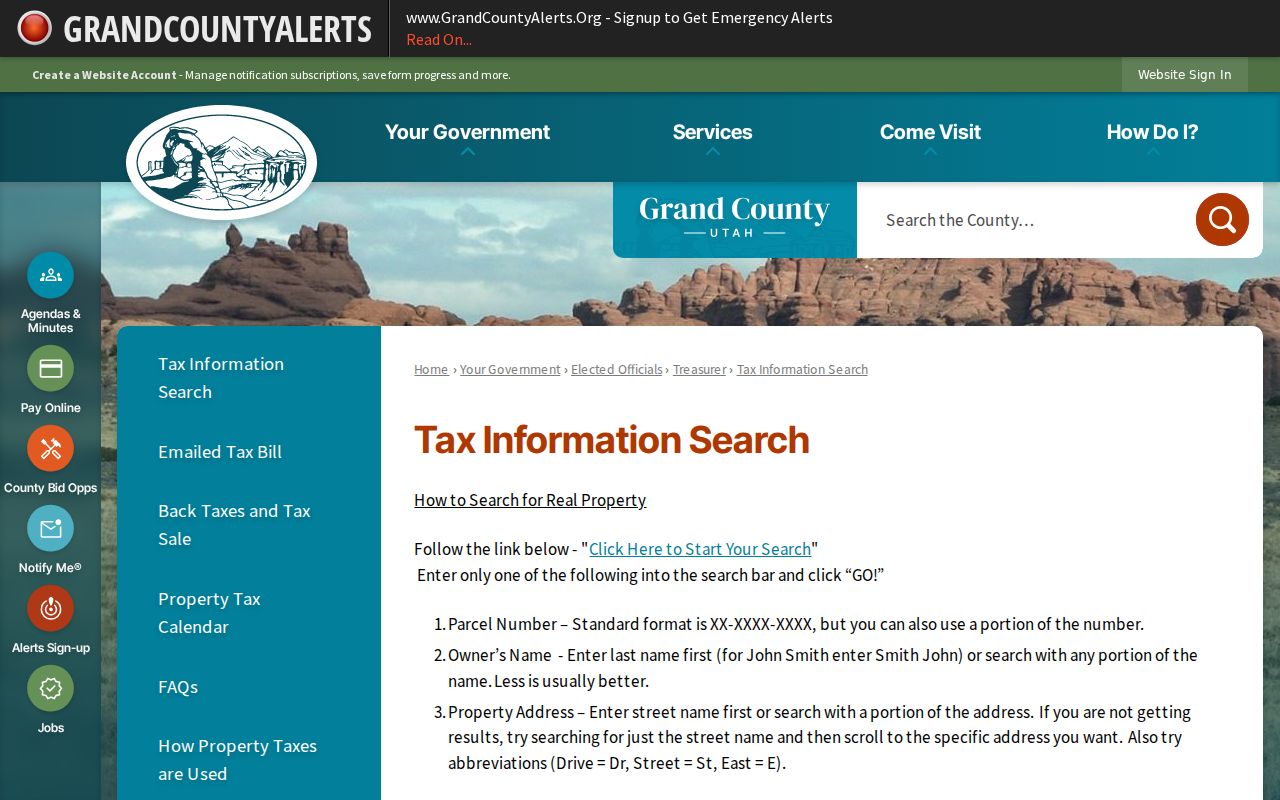
The county's public tax search returns a simple table. Columns cover Parcel, Owner, Property Address and City. Individual entries add a roll date, a status, and a back-tax interest date. No full field list appears there. The Assessor's page also never settles the card's name label, whether it reads Owner, Taxpayer or Owner Name. Treat the result table's Owner field as the verified label, and ask the Assessor to confirm the card's wording before describing it broadly.
| Owner | Name shown in the tax search result |
|---|---|
| Parcel | Tax parcel identifier for the record |
| Property Address | Situs location shown in the result |
| City | Tax result locality; verify the municipal line separately |
| Roll date / status | Date and status that qualify how current the result is |
| Deed confirmation | Latest recorded grantee, legal description and reception date |
Owner of record and occupant are different roles. A deed can vest title in an individual, a trust or an entity while somebody else lives there. The situs address points to the parcel. Tax notices go elsewhere when the mailing address differs, which happens often. Grand County's public sources do not confirm where every card displays a mailing address, so never assume it appears in the search result. Ask the Assessor for the detailed parcel record instead.
Check the Grand County Roll Date Before Calling an Owner Current
Timing decides whether an owner name is truly current. Grand County says the tax roll is generally uploaded most months, and each entry is accurate as of the date printed on it. That is not a promise every deed recorded in a given month has already flipped the Owner field. The current-year tax bill usually appears in early November. Billing availability is separate from the transfer date. Record both dates when you wonder whether the tax search has caught up with a closing.
A prior name on the tax result calls for the Recorder's AcclaimWeb index. Search by legal description and by likely grantee. Its public modes include Name, Reception Number, Book/Page, Legal Description and Record Date. The county publishes no fixed deed-to-roll lag. The earliest Acclaim online year is also unpublished. For a fresh transfer, the document's record date and grantee remain the better verification points.
Confirm the Current Grand County Owner in the Deed Index
The tax roll finds the parcel. Then check the Recorder's newest instrument. AcclaimWeb, the Grand County Recorder's index, offers party-name and legal-description modes plus a reception number, book/page reference and record date. Run the Owner name as a grantee. Verify the legal description and the deed's vesting language. If the deed names a prior grantor, search that party's earlier acquisition to confirm the chain. The roll name alone is no title opinion.
- Save the tax result’s Owner, Parcel, Property Address, City and roll date.
- Find the latest matching deed in AcclaimWeb and compare its grantee and legal description.
- Read the vesting language and any capacity such as trustee or personal representative.
- If the grantee is an entity, consult official state business filings; a registered agent is not necessarily a beneficial owner.
- Owner of record
- The person or entity named on a dated county record.
- Vesting
- The way the deed states an interest is held; read the actual instrument.
- Registered agent
- A designated business contact, not proof of who benefits from an entity.
Grand County Tax Codes Can Change the Record’s Meaning
Grand County's tax search uses short status codes. OK means active, XX deleted, IA inactive, NT not taxed, and EX exempt. The codes interpret the tax record only. They never change a deed's vesting or prove an owner moved out. A deleted or inactive line calls for a successor parcel search. An exempt status points to the assessment record and current exemption details. Note the back-tax interest date as its own field.
Never compare an old roll code with a current deed. Each record carries its own date. Confirm the date printed on the tax record and the recording date shown in AcclaimWeb. A status or owner name may stay unclear. Contact the Assessor with the APN and ask what the current parcel card says.
Mailing and Situs Addresses in Grand County Records
Situs and mailing addresses serve different jobs. The situs address identifies the property location. A tax mailing address receives notices, and it can sit somewhere else entirely. Grand County's public tax result confirms a Property Address column. It does not reveal where the mailing address appears on every card. A mailing address never proves residence. Request a parcel card from the Assessor when the official owner mailing record matters.
Utah Safe at Home offers a substitute address. It forwards mail for eligible participants. Certification lasts four years, with statutory exceptions for protected information. The county's voter privacy page separately explains which voter fields are public or private. It also covers how an At-Risk designation works. Each protection has a defined scope, and neither program changes every public land record. Utah Safe at Home explains enrollment eligibility and address protection.

The state's address-confidentiality page outlines how the program works. Direct specific eligibility questions to the program or an authorized assistant.
Ask the Grand County Assessor for the Parcel Card
A parcel-card request settles questions the public tax search cannot. Labels and mailing addresses sometimes lag. When you ask, give the Assessor the parcel number, the situs address, and the owner name exactly as displayed. Include roughly when any recent transfer closed. The office sits at 125 E Center Street in Moab, reachable at 435-259-1327 through 435-259-1330. No published service standard covers the gap between closing and roll. Ask about that parcel instead of trusting a general estimate.
No online card? Grand County's GRAMA portal takes a specific request. Ask for the current assessment and owner information by parcel and date. Check with the custodian on fees or inspection options. The who owns a Grand County property walkthrough covers the wider ownership workflow. The former owner records page lists prior grantees.
When a Recent Grand County Deed Leads the Tax Roll
County tax instructions say new rolls upload most months. The current-year bill normally posts in early November. Neither statement promises how fast a recorded closing updates the Owner field. So if the newest deed names a grantee the tax search still calls the former owner, write down each source's date. Then ask the Assessor whether the roll has caught up. Run both names plus the legal description through AcclaimWeb before treating the mismatch as an error. The county's search instruction page documents the roll date. It also documents the search modes behind this cross-check.
Treat the official tax search as your roll snapshot. Confirm anything newer in the Recorder's deed index.
Contact a Grand County Property Owner Through the Record
For a legitimate property matter, the tax-correspondence address is a formal contact clue. The county's public search does not prove it is current. It may not reveal a private residence either. Route a safe, accurate request through the custodian. Or use a published business contact when the grantee is an entity. If no mailing address appears, do not work around a confidentiality program. Ask the Assessor which record is public, and respect any protected status.
Lawful use. Use Grand County owner information only for an appropriate property or public-record purpose. Do not use it to stalk, harass, intimidate or harm any person.