
Recorded Instruments in Grand County’s Deed Trail
Deed research in Grand County starts with the Recorder. The Recorder's official index is the hub for tracing land transfers. A Grand County deed records search can show who sold, who bought, and when a parcel changed hands. It also gives the county's reference number for each filing. Mortgages, liens, easements, releases, plats, and surveys often sit in the same index. You can search Grand County deed records by party name or reception number. Then follow the chain backward through earlier owners. Keep one caution in mind. An index entry is not a title opinion. Confirm details with the Recorder or a title professional before drawing conclusions.
| Deed Type | What It Does | Common Use |
|---|---|---|
| Warranty deed | Conveys the interest described with stated warranties | Common in an arm’s-length transfer |
| Quitclaim deed | Transfers whatever interest the grantor holds | May appear in family or title clean-up transfers |
| Personal-representative deed | Conveys an estate interest under representative authority | Estate distribution or probate sale |
| Tax deed | Documents a transfer following a tax process | Review with delinquency and court records |
| Deed of trust / release | Records a security interest or its release | Follow both the initial filing and release |
Deeds and encumbrances share the same land record trail, yet they answer different questions. A deed names the parties and describes the interest transferred. A deed of trust, federal tax lien, easement, or restriction can burden a parcel. But it does not make its holder the owner of record. Paying off a loan is not the same as recording a release. Search for the later instrument itself. Then compare its reception number and legal description against the earlier filing.
Grand County AcclaimWeb Search Modes
The public AcclaimWeb landing page offers several search modes. These include Name, Book/Page, Reception Number, Legal Description, Remarks, Doc Type, Sales Price/Documentary Fee, and Record Date. Such fields bridge an index entry to the actual document, whether paper or electronic. A name search cannot replace the legal description. The Recorder cautions that names may require spelling variations. The office also notes that data accuracy is not guaranteed. The county publishes no online coverage start year, image cutoff, result limit, or full Doc Type list.
| Index mode | What to enter | Use in a title trail |
|---|---|---|
| Name | Grantor or grantee; test variants | Find the parties on a transfer |
| Book/Page or Reception # | Reference copied from a prior record | Open the specific filing |
| Legal Description | Lot, block or legal text | Follow the same land across name changes |
| Remarks, Doc Type, Date | Index note, document label or date range | Narrow a search after locating the parcel |
| Sales Price/Documentary Fee | Indexed consideration-related field | Context only; not a guaranteed market value |
Open the Grand County Recorder's AcclaimWeb portal to accept the disclaimer and use its published search modes.
Follow Grand County Grantors and Grantees Backward
A grantor transfers an interest; a grantee receives it. Start with the current tax-roll owner as your grantee candidate, but confirm the name against the latest deed. From that document, capture each grantor and grantee, the record date, the reception or book/page reference, the document type, and the legal description. Next, search that prior grantor as a grantee. That search locates the earlier transfer. Repeat the process until the index no longer reaches the era you need, logging every reference so you can request the exact image or volume.
- Find the likely current owner’s acquisition deed as grantee.
- Copy the grantor name, parcel description and recording reference from the deed.
- Search that grantor as an earlier grantee and compare the legal description.
- Repeat, keeping a dated list of each link and asking the Recorder about older deed books when the online trail ends.
- Grantor
- The party conveying the stated interest.
- Grantee
- The party receiving that interest.
- Chain of title
- The ordered succession of recorded conveyances for a parcel.
- Book/Page and Reception #
- Two reference routes shown in the Grand County index.
Read the Sales Price Field with Care
AcclaimWeb exposes a Sales Price/Documentary Fee search mode. County materials never claim every deed carries a full market price. The field may reflect consideration or a documentary-fee entry instead. Treat it as a lead. Read the actual instrument, then compare the transaction with the Assessor's value and date. A family conveyance, trust transfer, or partial interest can make the price field misleading. Such entries may not match an ordinary open-market sale.
For value questions, Grand County's annual sales-ratio study explains part of the picture. The Assessor's appraisal-area cycle explains how tax valuation works. The recorded deed evidences the filing itself. The tax roll supplies a separate assessment record. Keep sale price, assessed value, and taxable value distinct in your notes.
Request a Grand County Deed Copy or Certification
The Recorder publishes a $45 recording fee for a standard document. Reproduction charges are separate. In-office black-and-white copies run 50 cents for 8.5-by-11 or 11-by-17 sheets. Larger sheets cost $10 for 18-by-18 and $20 for 24-by-36. Email or mail copies are listed at $1, $5, and $10 by size. Certification costs $5 plus $1 for each additional page. Confirm current charges and the right format before submitting anything.
Subdivision plats follow their own schedule: $55 per sheet plus $2 per lot or unit designation. A Record of Survey electronic filing is $20 per page. When an index result is missing online, give the counter the reception or book/page reference, the parties, and the legal description. Staff can then locate it. The county publishes no exact image availability cutoff. Ask rather than assume an older deed is absent.
Property Watch Can Flag a New Recording
The Recorder's office runs a Property Watch signup as its property-fraud alert route, though the public page does not spell out the alert fields, triggering events, price, or notice timing. Confirm the scope with the office first. An alert only tells you an index entry exists, nothing more. It will not block a filing, prove a document fraudulent, or replace reviewing the recorded image yourself.
If an unfamiliar filing appears, note its reception number and date. Retrieve the document through the Recorder. Compare the names and the legal description. Then call the number on the official Recorder page. Suspected fraud calls for two conversations, one with the records custodian and one with a qualified title or legal professional. Skip unsolicited mailers that imitate a government notice.
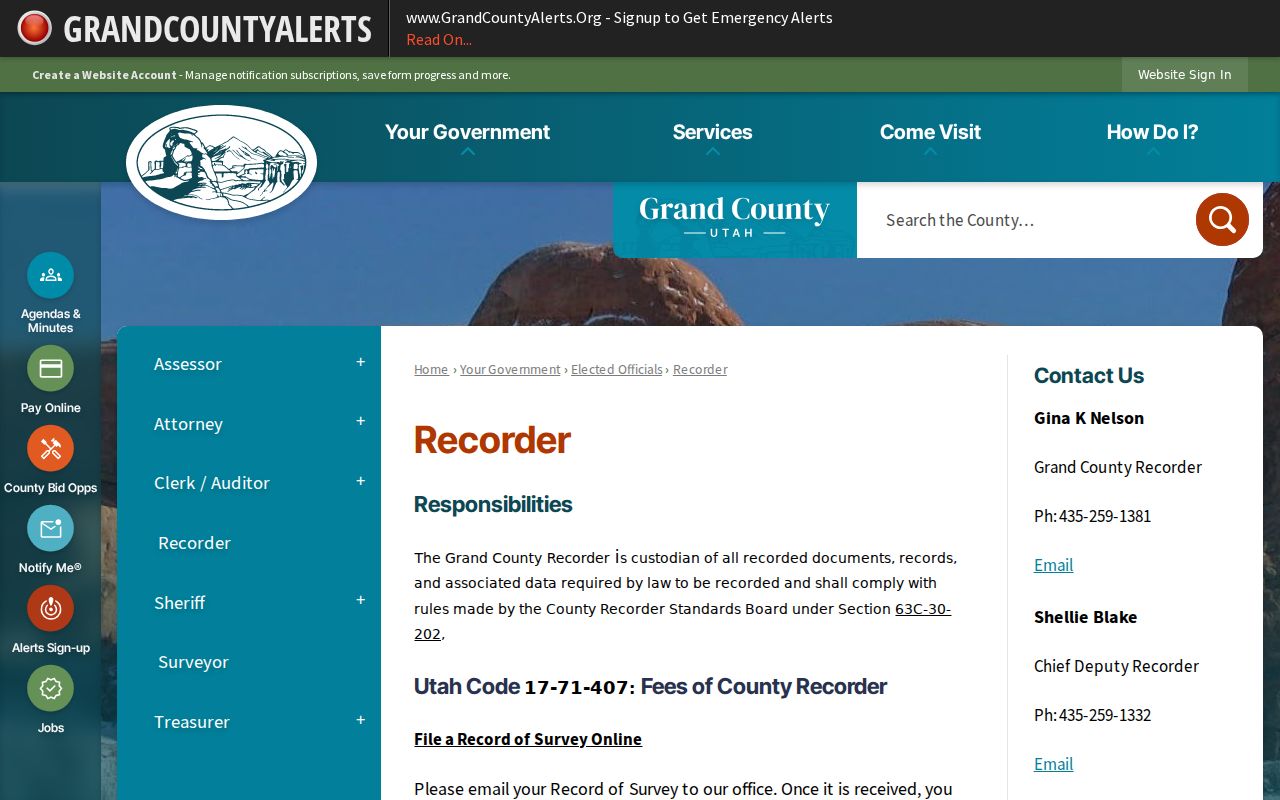
The Grand County Recorder page links the alert signup and the current fee schedule.
Confirm current alert terms with the Recorder before enrolling.
When the Grand County Online Deed Trail Ends
Grand County has never published AcclaimWeb's earliest online year. No image cutoff appears either. Nor is a deed-book or microfilm cutoff stated. Never import a starting year from a neighboring county's system, and never assume the first portal result is the first deed; ask the Recorder instead whether an older deed book, index volume, plat book, or microfilm reel covers the legal description and date range. Keep the last known grantor, grantee, reception reference, and legal description close; those details sharpen the deeper search.
The Utah State Archives is a fine parallel source. It holds Grand County assessment rolls from 1890 through 1996. Its tax-sale records reach 1998. Those series show who appeared on an assessment roll. They never replace the deed that transferred title. The Library's newspaper archive adds color around subdivision announcements, estate notices, and old road names. A complete title chain still means reconciling every lead with the recorded instruments themselves.
Get the Recorded Grand County Deed
An index reference opens two doors. Use AcclaimWeb's document image or contact the Recorder. The office sits at 125 E Center Street in Moab. The phone number is 435-259-1381. Counter hours run weekdays 8 to 5 with a noon-to-1 closure; staff provide plain or certified copies when you supply the reception number or book/page, party names, and legal description. Certified copies carry a separate published fee, so confirm the Recorder's current image and payment instructions before sending money.
Recorded, not guaranteed. The Grand County deed index points to recorded documents, not every possible interest in land. A title search by a qualified professional is needed to assess title status.