
Run a Grand County Property Search from the Best Clue
Grand County gives its tax roll search three doors. They are Parcel Number, Owner's Name, and Property Address. Pick one. Enter only one key at a time. The owner field wants the last name first and tolerates a partial. The address field runs on a street name or a fragment of one. The parcel field likewise accepts a standard number or part of it. Results show columns for Parcel, Owner, Property Address, and City. So weigh more than a familiar name before calling a match yours.
When the tax result surfaces a likely parcel, stop there. Copy down the APN and the legal description. Those two identifiers carry you across systems. Drop them into AcclaimWeb to inspect the recorded transfer. Drop them into the Parcel Viewer for map context. Rural address? Let GIS lead. A map clue can beat a street number. You can reconcile the identifier against the tax roll afterward. That order keeps a common mailing name from dragging you onto the wrong parcel.
- Choose one mode on the Grand County tax site: parcel, owner or property address.
- Record the parcel ID, owner, situs address, city and roll date from a promising result.
- Use the legal description or party names in AcclaimWeb to confirm the latest recorded deed.
- Open the county Parcel Viewer and compare the parcel’s location and adjacent lots.
- Ask the custodian for a copy if the indexed item is older, unavailable online or needed in certified form.
Grand County Tax Search Fields and Their Limits
Each Grand County search mode has its own quirks. Parcel Number takes the standard XX-XXXX-XXXX format, and partial numbers work too. Owner's Name goes last name first, so type "Smith John" for John Smith. Partial text is encouraged there. Property Address starts with the street name and also accepts fragments.
Abbreviations matter. If a full address returns nothing, try Dr or St. Use them in place of Drive or Street. A directional like N or E can serve as its own clue. When a search comes up empty, remember that silence proves nothing. It says nothing about whether the parcel or deed records exist.
| Tax search field | How to enter it | Best use |
|---|---|---|
| Parcel Number | Standard hyphenated ID; partial accepted | Known parcel or GIS cross-check |
| Owner’s Name | Last name first; partial text | Finding parcels associated with a name |
| Property Address | Street first; partial text and abbreviations | Locating a site when its APN is unknown |
The county’s tax search instructions are the source for these fields and formatting examples.
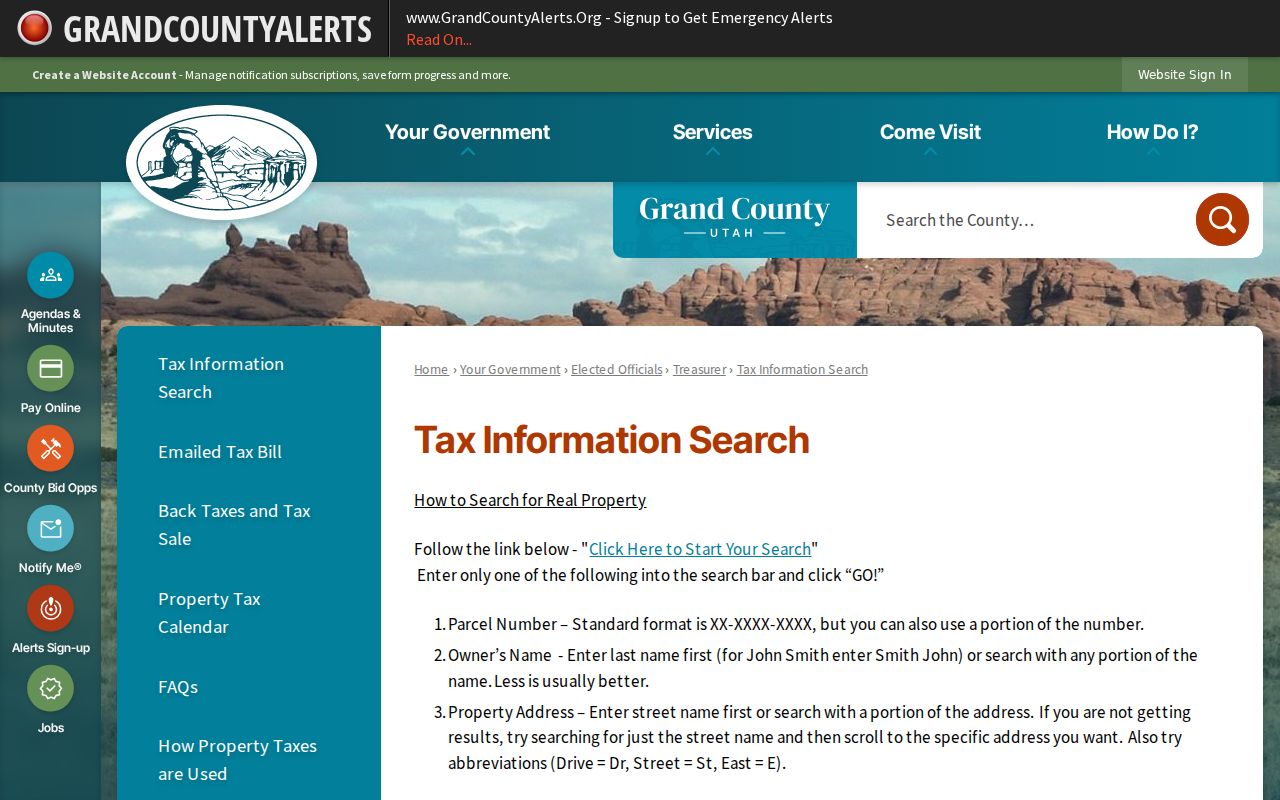
The county's tax page offers three ways in. Pick the key that fits the parcel you hold. One route will usually beat the rest.
Use a Street-Only Search to Find a Grand County Block
Address searching earns its keep when a house number has changed. It also helps if part of the address is missing, or the parcel sits on a rural road. Grand County accepts partial address text. Its own guidance suggests trying street-name variants and common abbreviations. Run the road name alone. Then scan the Property Address and City columns that come back. A single corridor can return several parcels. So compare the exact situs, the APN and the legal description before settling on a match. Resist the pull of the first familiar surname. A street-only search also teaches you the local naming pattern. The same road may show up with a directional. It may also appear with a shortened suffix, or an older locality name. Treat the address as a way to find candidates. But hold on to the parcel number as the key that ties systems together. For an address near a city edge, check the map before assuming anything. A Moab or Spanish Valley mailing name does not fix a municipal boundary. The lot may sit in unincorporated county territory instead.
Read a Grand County Tax Result as a Parcel Card
A Grand County tax result reads like a parcel card. It shows the parcel number, the owner of record, the property address, and the city. Each record also carries a status code. The roll date appears there too. You will see the date through which back-tax interest is calculated. This matters if a tax bill has gone unpaid. No complete assessor-card field list is published. So the search result's Owner column is your lead rather than the card's exact label. Ask the Assessor to confirm the field name on the detail card. It may be called Owner, Taxpayer, or Owner Name. One more wrinkle: the mailing address and the situs address may differ. The county also publishes no figure for how quickly the tax roll updates after a closing.
| Parcel | Tax parcel key; compare with the GIS serial format |
|---|---|
| Owner | Name shown on the roll; confirm transfer in the latest deed |
| Property Address | Situs address used to identify the location |
| City | Tax result locality; not a substitute for a boundary map |
| Status and roll date | Whether the parcel is active and when the entry was current |
| Back-tax interest date | Date through which displayed interest is calculated |
A tax result is not a title report. It cannot tell you that no other lien, easement or unrecorded interest exists. For recorded deeds and encumbrances, go to the Recorder index; for valuation or classification questions, use the Assessor's parcel file. When a sale has just closed, the deed reception date is the better transfer checkpoint. A monthly tax-roll upload will not always reflect the closing that fast.
Convert a Grand County GIS Serial into a Tax Parcel
A compact GIS serial will not always drop cleanly into the tax search. Grand County gives two examples. Serial 015550001 converts to 01-0555-0001. Serial 02MWA0015 converts to 02-0MWA-0015. In each case the standardized parcel number gains punctuation and a zero, so the fix is pure formatting, not a different identifier. Do not invent an unfamiliar APN by analogy. Check the tax instruction page, or ask the Assessor to reconcile it.
Cross-Check the Tax Parcel in AcclaimWeb
Grand County's Recorder exposes Name, Book/Page, Reception Number, Legal Description, Remarks, Doc Type, Sales Price/Documentary Fee and Record Date searches. Carry the parcel's legal description and owner name in. Check a recent grantee entry first. Then run the prior owner as grantor. Try spelling variants. The Recorder's own disclaimer warns that indexing errors happen, so a single clean query is rarely enough. A missing online result is not a verdict. It should prompt a second query or a call to the custodian rather than a conclusion that the transfer never happened.
AcclaimWeb's public landing page requires disclaimer acceptance and a JavaScript-enabled browser. The county publishes no firm online start year, image access cutoff, or complete document-type list. Fees sit on a separate Recorder schedule. Recording a standard document costs $45, certification runs $5 plus $1 for each additional page, and plain copies vary by size and method. Ask which charges apply before you order.
Continue with the Grand County deed records walkthrough for the backward title-chain method.
Decode Grand County’s Tax Status Codes
Tax search results in Grand County can carry short status codes. OK means active. XX means deleted, IA inactive, NT not taxed, and EX exempt. These codes describe the tax record only. They are not legal conclusions. They do not settle who owns a parcel or whether a transfer was valid. A parcel marked deleted or inactive has not vanished. Search by the current address or the recorded legal description. Then ask the Assessor what replaced the line.
The record also prints a "Back Tax Interest Calculated through" date. That date frames any accrued charges and may not be today's. Check the current bill separately. Check the Treasurer's status separately, especially for an older tax year or a planned payment. Codes are flags, not findings. A status code is one field in the search result, not a complete account history.
Check the Roll Date Before Calling a Search Current
Grand County loads fresh rolls most months. The printed date on a result shows how current it is. Check that date first. The current-year bill normally appears in early November. The county promises no fixed lag between a recorded closing and the updated tax roll, so a newly filed deed may lead the tax result. Compare the Recorder's reception date, the roll date, and the deed's grantee. A mismatch is not automatically an error.
Payment pages run on their own timing and fee rules. Instant Payments can display a bill or statement without payment. Card transactions carry a 2.5 percent fee with a $2.50 minimum. One-time eCheck is free. Recurring eCheck costs 49 cents. Confirm current conditions with the Treasurer before submitting anything.
For payment status, use the Grand County Treasurer route; this property search is for locating the parcel and its record keys.
Moab Permit Forms Carry an Assessor Parcel Key
A City of Moab building-permit application opens by asking for the building address and the assessor parcel number. It then records the owner or permittee. Mailing address, authorized agent, contractors and license numbers follow. Project details come next. The form lists residential or commercial use, zone, valuation, improvement type, floor area, stories, bedrooms and bathrooms, occupancy, sprinkler and parking information, site plan, floodplain details, water and sewer, and fee fields. That structure lets a permit file reconcile an address with an APN without treating the applicant as the owner of record.
The city's online permit work runs through the iWorQ portal, which requires live interaction. Historical coverage and public result fields are not listed there. The Building Safety page is the city's entry point for online forms and inspections. Treat the APN as the anchor. The county tax result gives the current owner lead. The Recorder settles title.
The City of Moab Building Inspection page links the permit portal and submission guidance.
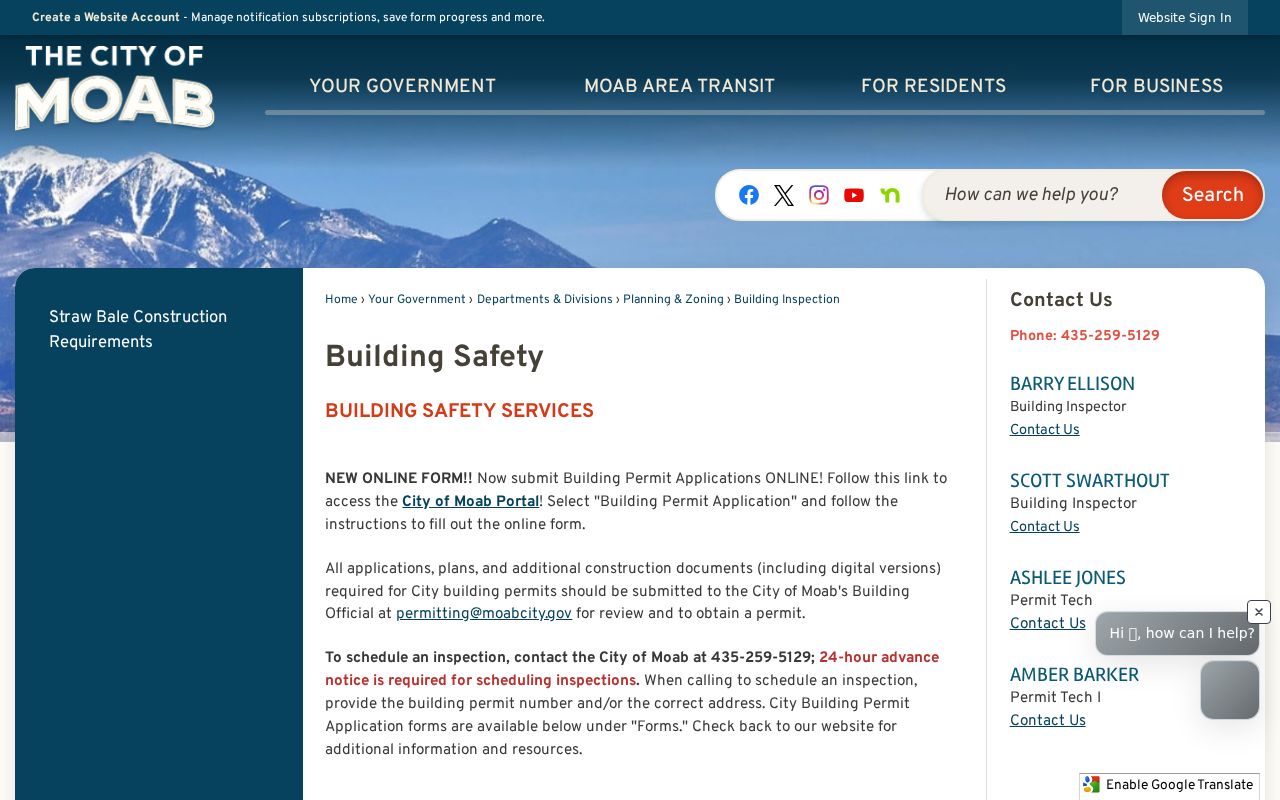
City guidance points to the permit route as the path for older files. Request a specific historical file from the city if the public portal does not expose it.
Choose Address, Owner or Parcel in Grand County
Each search key has its moment. An address works best when you know the physical site, though spelling, road suffixes and boundary changes can trip it up. Owner names help with multiple parcels. Common names, trusts and LLCs need a deed check. A parcel number is the cleanest handoff. Tax, map and recorded-document systems all speak that key once you hold it. In Grand County, normalize a GIS serial against the county's examples before submitting a parcel search.
| Search Key | Best For | Where It Works | Watch Out |
|---|---|---|---|
| Address | Known physical location | Tax search or GIS | Try partial street and suffix variants |
| Owner name | Finding parcels tied to a party | Tax search or AcclaimWeb | Names may be indexed with variants or entities |
| Parcel number | Matching the same lot across systems | Tax, GIS and Recorder | Compact serial may need county formatting |
Not a title search. A Grand County property search finds public record entries; it does not guarantee clear title or disclose every unrecorded interest. Use a title professional or attorney for a title opinion.