
Different Values on a Grand County Property Record
A property record can carry several numbers. Market value from the Assessor is a mass-appraisal estimate for taxation. Taxable value reflects the tax treatment that applies. A recorded sale price captures a specific transaction, if the deed index lists it. The Recorder's AcclaimWeb index offers a Sales Price/Documentary Fee search mode, though public materials do not promise every entry shows a full price. Match the value type, date and source before judging any parcel.
| Value | What It Is | Where |
|---|---|---|
| Assessor market value | County’s annual tax valuation estimate | Grand County Assessor |
| Taxable amount | Value after applicable tax treatment | Assessor and Treasurer records |
| Recorded consideration | Transaction-related index field when present | AcclaimWeb document entry |
| Land / improvement attributes | SGID fields may include land value and building context | Utah parcel layer; check date and source |
Grand County describes its annual sales-ratio study in public information. But it publishes no single parcel's appraisal result. A sale proves value for one date and one condition. It is not automatically the current assessed value. The tax bill adds rates and exemptions. So a bill total is not the property's value either. Fields like TOTAL_MKT_VALUE and LAND_MKT_VALUE in the state parcel layer offer another dated reference. They are not an independent appraisal.
Grand County’s Annual Sales-Ratio Study
Each year the Assessor runs a sales-ratio study. The office updates the assessment roll at least annually and finishes appraisal areas on a five-year cycle. Those steps let the county test values against market activity. They also spread appraisal work across areas over time. A five-year cycle is a review schedule. It does not freeze a parcel's value for five years. The year printed on the record still matters, and so does the owner's valuation notice.
One neighboring sale proves little. Grand County publishes no Moab- or Castle Valley-specific revaluation percentage. It publishes no fastest-appreciating district and no historic-overlay premium. Do not assign a citywide percentage without county data. Instead, compare similar property characteristics and the parcel's current assessment evidence.
Look Up a Grand County Property’s Assessed Value
The Grand County tax search finds a parcel by address, owner or parcel number. The result table lists Parcel, Owner, Property Address and City. The full assessor card's valuation labels stay harder to see. Verify the exact value fields and year on the parcel record or with the Assessor. Keep the parcel key and roll date with each value.
- Find the parcel in the county tax search using address, owner or APN.
- Record the value type, tax year and date printed on the roll.
- Use AcclaimWeb to inspect the recorded deed and any available consideration-related entry.
- Compare the subject with similar parcels and the Assessor’s appraisal-area information.
- Assessed value
- The Assessor’s value used in the tax system.
- Taxable value
- The amount subject to tax after applicable exemptions or adjustments.
- Recorded price
- Consideration tied to a specific deed, when indexed or visible.
Check Parcel Characteristics Before Comparing Values
Utah SGID parcel fields can include acreage, property class, primary residence, house count, building square footage, floor count, year built and effective year built. These are context, not an inspection report. Compare like with like. Lot area, improvement size, age, class and location often explain why a nearby parcel makes a poor value comparison. Update dates can differ between the county GIS view and the state layer. Check the source and its "current as of" metadata.
The public assessor page notes that staff visit new construction and maintain property file cards. If a characteristic looks wrong, provide the parcel number. Ask the Assessor how the card was developed. A map image or permit application can cross-check a detail. Neither replaces the official assessment file.
Grand County Recorded Sale Price Is a Separate Clue
AcclaimWeb includes a Sales Price/Documentary Fee mode. The label joins two related ideas. County materials do not promise that every deed carries a complete market price. Read the instrument itself and its consideration context first. A transfer between relatives, an estate conveyance, a partial interest or a non-sale instrument may not reflect an open-market deal.
For value questions, use the Assessor's annual process and the parcel's notice. For transaction questions, use the recorded deed. For amounts due, use the Treasurer. Keeping those sources separate matters. It keeps a documentary fee, tax value or bill total from being reported as a market price.
Exemptions Change the Grand County Taxable Amount
The Assessor sets real-property market value. The Treasurer bills the tax. Exemption and abatement applications also go to the Treasurer. Ask either office which rule fits the parcel and tax year, since the county publishes no complete list of exemptions, eligibility tests or filing forms. A lower bill never means a lower value.
Tax districts shape the bill too. County materials list Moab City, Castle Valley Town, fire districts, schools, cemetery and other taxing entities. A district changes tax responsibility, not assessed value. That matters near Castle Valley, where the Castle Valley Fire service area reaches outside town boundaries.
Appeal a Grand County Value on the Current Calendar
The 2026 Board of Equalization set its appeal deadline at September 15, or 45 days from the notice mailing date, whichever comes later. Initial in-person hearings ran September 2 through 4. The standard window has closed. A later notice, though, can keep the 45-day alternative open for a particular parcel. These dates belong to the 2026 cycle alone, so do not carry them into another year.
Trust the live BOE instructions instead. Use the current appeal form, and confirm the notice mailing date before assuming a deadline has lapsed. An appeal targets the assessment only. Billing and payment questions belong to the Treasurer. If every applicable window has closed, ask the county what review route remains available. Grand County's Board of Equalization page posts the current-year instructions.
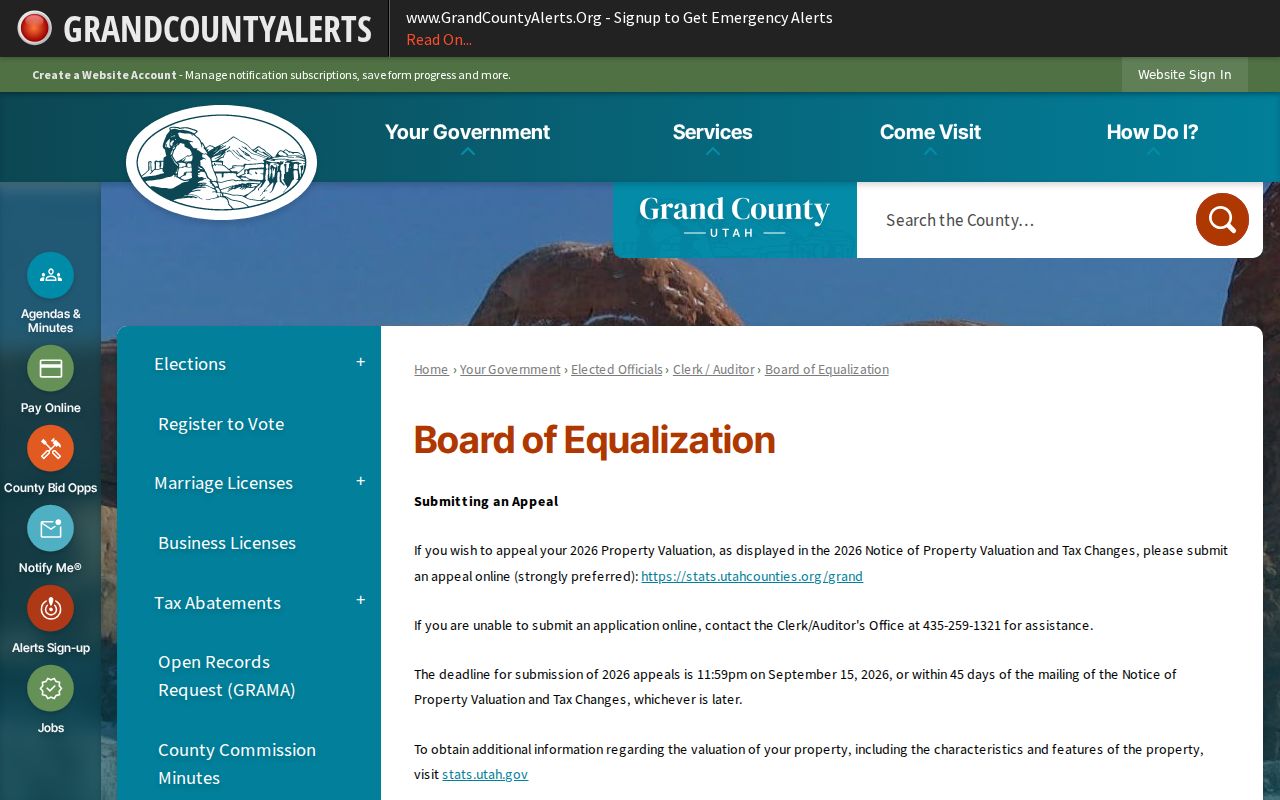
That appeal screenshot ages fast; confirm deadlines on the live page.
Moab and Castle Valley Need Parcel-Level Value Context
Moab spans roughly 3,050 acres. Its residential, commercial, industrial and mixed-use land sits near federal holdings, Arches National Park, SITLA tracts and Spanish Valley's county planning area. Those contexts shape nearly every comparison. Castle Valley grew from ranch parcels. Its low-density setting is distinctly different, and its fire district reaches beyond the town. Neither town publishes a town-specific appreciation or revaluation rate.
Anchor comparisons in the parcel itself. Use its actual class, characteristics, appraisal area, tax year and recorded sale history. A mailing-address city, or a taxing district on the bill, is not a valuation neighborhood. When two similar sites carry different values, request the Assessor's explanation for that particular parcel.
What a Grand County Assessed Value Cannot Tell You
The Assessor's number is a mass-appraisal figure for tax administration. It is not a signed valuation. It cannot back a sale, loan or insurance decision. It may also reflect a different date or appraisal area than a recent transaction. The Recorder's sales-price field is no complete market measure. Use a licensed appraiser for a current market opinion, and check the Assessor's record for the county's taxable valuation.
Value vs. price. A Grand County assessed value is not a promise of what a parcel will sell for. For a transaction or lending decision, obtain an appropriate independent appraisal.